




Newsletter: 179
Date: October 6, 2025
Report on the Economic Situation and Tax Pressure in Spain (October 2025)
The Spanish economic outlook is currently characterised by remarkable dynamism compared to the euro area average, with growth indicators that have led to upward revisions by the main organisations.
The Spanish economy has remained more robust than expected, driven mainly by domestic demand.
- Gross Domestic Product (GDP)
The consensus of analysts suggests that GDP growth for the whole of 2025 will be in the range of 2.6% to 2.7%, although some more recent projections raise it to 2.9%.
- Growth Engine: The basis of this growth is Domestic Demand, supported by the strength of private consumption (thanks to the recovery of purchasing power) and investment, complemented by a good performance of the tourism sector.
- Quarterly Context: Year-on-year growth has remained at significant levels (example: 3.1% year-on-year in the second quarter of 2025), which generates a positive carry-over effect for the final part of the year.
- Inflation (CPI)
The headline inflation rate (CPI) is expected to remain above the 2% threshold throughout FY2025.
- Forecast: Consensus estimates put the headline inflation rate for the end of 2025 at around 2.4%, with a core rate (which excludes energy and unprocessed food) in a similar range.
- Impact: Price control remains a key factor, although the year-on-year rate in December is expected to moderate, according to projections.
- Employment and Additional Factors
The labour market shows no signs of cooling, with the number of employed people exceeding record highs. However, surveys reflect economic scepticism in part of the population, motivated by the perception of a loss of purchasing power of wages.
Tax Burden on Spanish Taxpayers (2025)
The tax burden on Spanish taxpayers has been a central issue in 2025, marked by the increase in collection and the introduction of new contributions and tax rates for high incomes.
- General Fiscal Pressure
Spain has experienced an increase in its total tax burden (taxes and contributions in relation to GDP) of 1.9 percentage points since 2019, while the European Union average has tended to reduce it.
- Total Labour Load: In terms of labour cost, the cumulative taxation (Social Contributions, Personal Income Tax and VAT) on an average salary amounts to approximately 47.8% of the total labour cost.
- Specific Changes and Developments for Taxpayers in 2025
| Tax/Levise | Change or Situation in 2025 | Taxpayer Impact | |
| Personal Income Tax (Capital Income) | The tax rate for savings income exceeding 300,000 euros per year was increased, from 28% to 30%. | It affects income generated by deposits, dividends and sales of assets for higher incomes. | |
| Personal Income Tax (General Income) | The structure of state brackets is maintained, with a maximum marginal rate of 47% for the highest incomes (from €300,000). | Progressivity is maintained on the general basis. | |
| MEI (Intergenerational Equity Mechanism) | The additional contribution was increased from 0.7% to 0.8% of the contribution base. | The percentage paid by the worker is 0.13% (the remaining 0.67% is assumed by the company). | |
| Solidarity Fee | New tax applied to salaries that exceed the maximum contribution base (currently €58,908 per year). | Progressive rates of between 0.92% and 1.17% are applied to the part of the salary that exceeds this base. | |
| VAT on Electricity | The VAT rate on electricity bills returned to the general rate of 21%. | It means an increase in the cost for final consumers of electricity. | |
| Self-employed (MEI) | Self-employed workers assume the entire increase in the MEI, which implies an increase in their monthly payments for the highest income brackets. | There is an increase in the fee, especially for those with incomes above €1,700/month. |
Traceability of Information (sources)
The information contained in this report is based on data and projections from official bodies and independent analysis houses, contrasted and verified:
- Macroeconomic Forecasts (GDP, Inflation): Bank of Spain, OECD, Funcas and CaixaBank Research (data updated to September/October 2025).
- Tax Burden and Contributions: Juan de Mariana Institute, Tax Agency and specialised analysis in taxation and Social Security for the 2025 financial year.
The PET market.
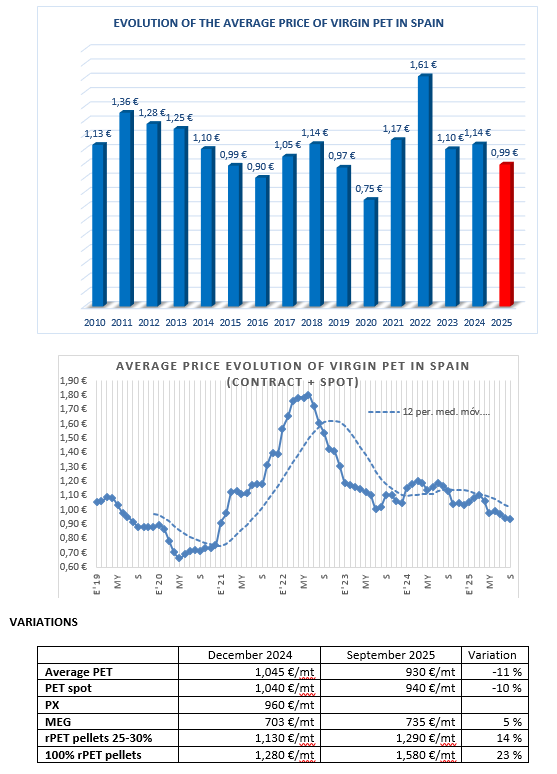
The PET market in Spain is heading for a quiet last quarter of 2025 in terms of prices, continuing the downward or stabilising trend observed after the peak in 2022 and the sharp decline in 2023.
The key to the market is the downward pressure from the end of seasonal demand and import competition. Only an unexpected increase in the price of crude oil or coordinated action by PET producers could alter this trend and generate increases before the end of the year.
BRENT
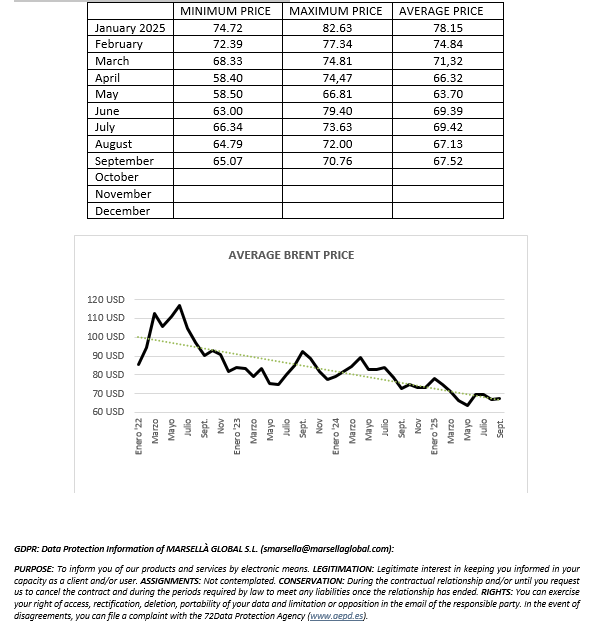
The dominant outlook for the end of 2025 is a market with a surplus of oil, keeping prices in a range of $60 to $70 per barrel, unless an unexpected geopolitical event or a drastic decision by OPEC+ changes the balance.
Brent Oil Evolution and Projection for 2025 (USD)
This newsletter is prepared based on the information and experience of our sales team. Marsella Global, SL pays special attention to its preparation, however, we cannot guarantee the accuracy and usefulness of the content published.
The recipient accepts the content of this newsletter on the understanding that Marseille Global, SL is not responsible for any damage caused by the use of the information contained in this document.


Comments are closed.