




Newsletter: 178
Date: September 8, 2025
The Cost of Corruption in Spain (2004-2024):
A Multidimensional Analysis of Economic, Social and Political Impacts
(Crafted with the help of Gemini AI)
Executive Summary: The Immeasurable Burden
This report presents a comprehensive and multidimensional analysis of the cost of corruption in Spain over the last 20 years. While the call for a single, precise figure is understandable, this analysis demonstrates that such quantification is inherently impossible to achieve. The real cost of corruption is a systemic and multifaceted problem that goes far beyond the sum of direct financial losses.
From an assessment of macroeconomic estimates, a breakdown of the quantifiable costs of specific court cases, and a detailed study of the frequency of cases by political party, the following key conclusions are drawn:
- Financial Cost: There is no definitive figure for total corruption. However, macro-level estimates indicate that the annual cost to the Spanish economy amounts to a staggering amount ranging from 60,000 million euros to 90,000 million euros. This figure does not represent money directly embezzled, but revenue losses, reduced economic potential, and market distortions.
- Case Breakdown: Data from the most important court cases provides the most concrete information on direct losses. Among them are the ERE case (€680M) of the PSOE, the Gürtel case (€30M to €50M) of the PP, the Púnica case (up to €500M) of the PP and the Malaya case (more than €500M) that splashes the GIL and the PP. These figures, although fragmented, show the diversion of substantial sums of public funds.
- Political Dimension: A recent study by the University of Barcelona identifies a total of 3,743 cases of political corruption between 2000 and 2020. The two major parties, PP and PSOE, accumulate the largest number of these cases, which is directly correlated with the time they have held power at the national, regional and municipal levels. The study indicates that the PP is related to 80% of cases at the national level, while the PSOE leads the number of procedures in five autonomous communities.
- Systemic Impact: The deeper cost of corruption is incalculable. The most damaging effects include the profound erosion of public trust in democratic institutions, the significant deterrent effect on foreign direct investment, and a sense of pervasive social cynicism that perpetuates the problem.
The main conclusion of this report is that concentrating on a single monetary figure hides a much more important truth: the real burden of corruption in Spain is not only financial, but also institutional and social, which undermines the long-term stability and democratic quality of the country.
Chapter 1: The Quantification Challenge: Understanding the Elusive Cost of Corruption
The Inherent Challenges of Measurement
The question of the total amount of corruption in Spain is one of the most complex in economics and political sociology. Despite the great interest it raises, it is “impossible to quantify its cost precisely”. The main reason lies in the inherently hidden and clandestine nature of corruption.
By their very definition, acts of corruption are carried out in secret and often by mutual agreement between the parties, meaning that much of this illicit activity is “never discovered or prosecuted.”
To address this issue, two main types of data are used that are not directly comparable and that offer very different perspectives on the problem:
- Perception Indexes: Organizations such as Transparency International publish the Corruption Perceptions Index (CPI) annually. This index, which assigns each country a score from 0 to 100, measures the perception of corruption in the public sector. A high score indicates a lower perception of corruption, while a low score suggests the opposite. Spain scored 56 points in 2024, having averaged 61.79 points between 1995 and 2024, with a high of 71 points in 2002 and a low of 43.10 in 1996. While this index is useful for comparing perceptions over time and across countries, it does not provide a monetary figure.
- Judicial Data: Investigations and court rulings offer the most concrete data on corruption, but they only capture a fraction of the total problem. A study by the University of Barcelona, which is based on manual information collected from the media, found 3,743 cases of political corruption between 2000 and 2020, a figure that “quadruples or quintuples” previous estimates that were based solely on official judicial databases.
The disparity between these datasets reveals a gap between public perception and judicial reality. It is critical to recognize that even when cases are not prosecuted or archived, the mere perception of corruption already has very real consequences. The existence of corruption ends up being accepted as something “widespread and inescapable”, which “generates a social substrate favourable to corruption continuing to thrive, feeding the vicious circle of mistrust”.
- The Dual Nature of Cost: Direct vs. Indirect Indirect
The cost of corruption can be divided into two main categories:
- Direct costs: These are the easiest to understand and, in some cases, to quantify. They include money directly stolen through embezzlement of public funds, bribes, diversion and fraud. Clear examples of these costs are the funds diverted in the ERE case or the value of the rigged contracts in the Koldo case.
- Indirect costs: It is often argued that these costs are much more significant than direct losses. These are the “externalities that detract from the economy’s potential”. These include reduced economic growth, declining foreign investment, distorted decision-making, loss of trust in institutions, and erosion of the social fabric.
- Methodological Reflections
The difficulty in measuring corruption is not a mere statistical issue; it reveals deeper problems in the institutional and social structure of a country. Corruption is not simply a series of isolated criminal acts, but a symptom of “weak institutions and systemic governance problems.” The lack of transparency, the poor implementation of anti-corruption regulations and the lack of resources for the authorities are factors that contribute to its proliferation.
In addition, corruption has become a tool in the political debate. Excerpts from public debates demonstrate how corruption cases are used to attack political rivals, as in the “Koldo case”. This political instrumentalization of the problem can generate the perception that the fight against corruption is a partisan “hunt” rather than a genuine effort for justice. This phenomenon, coupled with the tendency of voters to experience “greater revulsion towards PSOE news than the other way around” and vice versa, contributes to a cycle of mutual distrust and cynicism that undermines the democratic system as a whole.
Chapter 2: The Macroeconomic Burden: Aggregate Financial Estimates
2.1 The Annual Cost to the Spanish Economy
The aggregate quantification of corruption is based on its impact on key indicators, such as gross domestic product (GDP) and tax collection. These estimates, while not a sum of specific cases, attempt to capture the systemic and opportunity cost.
- A report by the Greens/European Free Alliance estimated that corruption costs Spain more than 90,000 million euros a year. This document argues that, if this amount were distributed, each Spaniard would receive 1,949 euros per year.
- A study by the International Monetary Fund (IMF) and another by the BBVA Foundation, cited by the World Compliance Association, suggest that the cost to Spain could be at least 60,000 million euros per year. This estimate focuses mainly on the loss of tax revenues and is considered a “downward” figure.
The BBVA Foundation study delves into this impact by suggesting that ending corruption could increase GDP per capita by 16% within 15 years, which translates into annual economic growth of around 1%. The cost of corruption is not only what is lost, but also what is not gained. Therefore, the real cost is not the money that comes out of the public coffers, but the loss of opportunities for the development and well-being of citizens.
2.2 Impact on Investment and Economic Potential
Corruption has a direct and detrimental effect on the business climate and investment. A corrupt environment reduces investor confidence and “slows down investment.”
- Spain has recently dropped out of the “top 10” of the most attractive countries for foreign investment, after having remained there for four years.
- An analyst points out that the “flight of foreign investment in Spain is doubled” and that many clients opt for other countries “more for this reason than for tax pressure”.
Legal uncertainty, slow public administration and lack of regulatory clarity are all contributing factors to this capital exodus. An environment where decision-making is “not made in the best interest of the public” but of corrupt individuals is an environment in which companies that wish to operate ethically are at a “business or financial disadvantage.”
Chapter 3: The Microeconomic Impact: A Breakdown by Case
3.1 Introduction to Case-Level Data
The corruption cases uncovered by the justice system and the media offer the only concrete window to direct losses. However, it is vital to remember that these figures are fragmentary and represent only a visible part of the problem. The hidden nature of corruption makes it impossible to know the real total of the money diverted. The quantifiable costs of the most significant cases of the last 20 years are detailed below, with a breakdown by political party.
3.2 Quantifiable Cases Linked to the Popular Party (PP)
The Popular Party (PP) has been at the center of some of the biggest corruption scandals in Spain.
- Gürtel case: The investigations put the money moved by this network at 30 million euros. Despite this, the PP was sentenced to pay a fine for civil liability for profit in the amount of 245,492 euros. Other broader estimates, which include the funds of the plot, suggest a cost of up to 50 million euros. A source links the Gürtel, Lezo and Púnica cases to a total of 1,400 million euros defrauded.
- Púnica Case: One of the main corruption plots linked to the PP, which has been estimated to have diverted an amount close to 500 million euros.
- Malaya Case: Considered the largest case of urban corruption in Spain, with an estimated initial looting of 500 million euros from the public coffers of the Marbella City Council.
The convictions associated with this case included a fine of 240 million euros for the main defendant. The total amount has been reached at 563.6 million euros, which would have been enough to pay Marbella’s debt 1.2 times.
3.3 Quantifiable Cases Linked to the Spanish Socialist Workers’ Party (PSOE)
The Spanish Socialist Workers’ Party (PSOE) has also been the protagonist of serious corruption scandals, especially at the regional and municipal level.
- ERE case (Andalusia): This case, which has been described as the one with the greatest embezzlement of public funds, was estimated at 680 million euros diverted between 2000 and 2009. The money was embezzled through transfers of funding to a public agency for social and labour aid, and the cost has been calculated at more than 200 euros for each Andalusian family.
- Koldo case: A more recent scandal, which involved the purchase of masks during the pandemic worth 54 million euros. The contracts were awarded to a company with no previous experience in the sector, and the alleged collection of commissions is being investigated. The cost is broken down into contracts such as 7.3 million euros from the Government of the Canary Islands and 3.7 million euros from the Government of the Balearic Islands.
3.4 Other Relevant Cases
The phenomenon of corruption has affected other parties and the public sphere in general.
- Filesa Case: Illegal financing of the PSOE for a value of 7.21 million euros in 1990.
- Roldán case: The former director of the Civil Guard was convicted of embezzling more than 10 million euros of public funds.
- Tabacalera Case: A case of alleged illicit enrichment through privileged information that generated a profit of 1.86 million euros.
- Pretoria Case: A plot that affected politicians from the PSC and CiU and that allegedly diverted some 44 million euros.
The following table summarises the financial costs of the main corruption cases in Spain, with the caveat that the figures correspond to presumed amounts, fines imposed or a breakdown of the costs of a global case.
| Case | Linked Party | Economic Amount | Data Origin and Context |
| Gürtel | PP | €30M – €50M | Amount of money moved by the plot. The PP was sentenced to pay €245,492. |
| ERE | PSOE | €680M | Amount embezzled between 2000 and 2009 according to the Prosecutor’s Office. Cost per Andalusian family of more than €200. |
| Punic | PP | ~€500M | Estimate of the total amount of the plot. |
| Malaya | GIL/PP | >€500M | Figures of the looting of Marbella. Fine of €240M to the main convict. Total amount of €563.6M. |
| Koldo | PSOE | €54M | Value of mask contracts. Former advisor Koldo García increased his net worth by €1.5M. |
| Filesa | PSOE | €7.21M | Amount of irregular financing of the party in 1990. |
| Roldán | PSOE | €10M | Amount of embezzled public funds. |
| Tobacco | PP | €1.86M | Profit allegedly obtained with privileged information. |
| Pretoria | PSC/CiU | €44M | Estimation of the amount of the plot. |
Chapter 4: The Immeasurable Costs: Social, Political and Institutional Erosion
4.1 Erosion of Public Trust
The most profound impact of corruption is not financial, but social. Political corruption “deteriorates institutional and social trust.” This phenomenon generates a widespread sense of pessimism and powerlessness, and the belief that no one can be trusted, especially when the institutions charged with prosecuting corruption, such as the judiciary and the police, are perceived as corrupt.
Although concerns about corruption in Spain have fluctuated, becoming one of the main problems for citizens, the underlying problem of mistrust persists. The lack of progress in the fight against corruption and the poor implementation of regulations contribute to an atmosphere of scepticism.
4.2 Damage to Governance and Democracy
Corruption is not a simple economic crime; it is an attack on the foundations of democracy. By distorting decision-making, corruption ensures that public policies are not decided in the best interests of citizens, but in the best interests of “the corrupt individuals involved.” This abuse of power undermines the credibility of governance and can foster “political dysfunction and social disunity.”
A particularly harmful aspect is the political instrumentalization of the problem. The use of corruption by opposition parties to discredit their rivals, as seen in televised debates, can backfire. Research shows that voters’ brains react with revulsion to news of corruption from the opposite party. This partisan bias can lead citizens to perceive anti-corruption efforts as a political strategy rather than a genuine pursuit of justice, which in turn further weakens faith in the system.
4.3 The Social and Human Price
The cost of corruption is also measured in lives and social welfare. The diversion of public funds means that less money is available for vital services such as roads, schools and hospitals.
Corruption disproportionately affects the most vulnerable groups in society, who are forced to pay bribes to obtain basic public services, violating their right to equality and non-discrimination. This global phenomenon also has links to environmental crimes and violence against environmental defenders, underscoring the serious human rights dimension involved.
Chapter 5: The Political Dimension: A Case Frequency Analysis
5.1 The University of Barcelona Study: An Alternative Metric
Since it is impossible to obtain a total and precise figure of the monetary cost, a study by the University of Barcelona (UB) offers a valuable metric to understand the magnitude of the problem: the frequency of cases. This research work counted 3,743 cases of political corruption – alleged and convicted – between 2000 and 2020 at all territorial levels.
The UB study reveals that corruption is a widespread problem throughout Spain, although it is concentrated in the largest populations. 85.2% of the cases occur at the municipal level, which shows that corruption is a deeply rooted scourge at the local level.
5.2 Distribution of Cases by Party and Region
The analysis of the frequency of cases offers a clear perspective on the distribution of corruption by political affiliation:
- PP and PSOE: The UB study indicates that the Popular Party (PP) and the Spanish Socialist Workers’ Party (PSOE) are the parties that “accumulate the most causes”. This conclusion is explained by the fact that they are the formations that have concentrated the largest number of mayors, provincial councils and regional governments during the period analysed.
-
- The PP accumulates the most cases of corruption by far, and is the party with the most proceedings in 7 of the 17 autonomous communities. The study indicates that, at the national level, 80% of corruption cases are related to the PP.
-
- The PSOE leads the ranking of corruption cases in five regions: Andalusia, Aragon, Castilla-La Mancha, Extremadura and Asturias.
- Regional distribution: Geographically, the province of Malaga has the highest absolute figure, with 258 cases, largely due to the Malaya operation. However, if the incidence per inhabitant is analysed, the Balearic Islands top the list with 18 cases per 100,000 inhabitants. As for the autonomous communities, the Junta de Andalucía (PSOE) has the highest number of open cases with 84, followed by the Balearic Islands (PP) with 66 cases.
5.3 The Relationship Between Power and Corruption
The analysis of the distribution of cases reveals that there is a clear relationship between political power and corruption. The parties that have held the most control over public resources and elected officials are predictably the ones with the most cases of corruption. The concentration of power and the opportunity for embezzlement are closely linked.
In addition, the study highlights a crucial finding: 70% of the cases of urban corruption have their origin in the stage of the real estate bubble. This shows that corruption is a phenomenon that adapts to and exploits the weaknesses of the system in specific economic situations. The explosion of cases revealed between 2009 and 2015 was a direct consequence of the investigations into irregularities that occurred during those years of economic boom.
Conclusions and Recommendations
Synthesis of Findings
Corruption in Spain over the last 20 years is a phenomenon of colossal magnitude, the cost of which cannot be reduced to a single figure. Macroeconomic estimates of between 60,000 and 90,000 million euros per year reflect the systemic burden of a problem that weakens economic growth and scares away investment. The court cases, although fragmented, document the diversion of hundreds of millions of euros of public funds, with episodes of embezzlement of an unprecedented magnitude, such as the ERE case.
The analysis of the frequency of cases shows a clear correlation between corruption and the exercise of power. The parties with the greatest institutional presence over time, the PP and the PSOE, concentrate the largest number of cases. This phenomenon is not only a problem of individuals, but of a system that allows and, in certain contexts, encourages fraudulent practices, especially in the field of urban planning. The deepest and most lasting cost is the erosion of trust in public institutions, generating a cycle of cynicism and disaffection that threatens the country’s democratic stability.
Strategic Recommendations
To effectively combat corruption in Spain, a comprehensive approach is required that goes beyond the mere judicial prosecution of individual cases. The following recommendations are derived directly from the analysis of the available evidence:
- Strengthen Transparency Mechanisms: It is crucial to standardize anti-corruption regulations and apply more rigorous transparency and accountability measures, especially in highly vulnerable areas such as public procurement.
- Boost Whistleblower Protection: Proper whistleblower protection is critical to uncovering hidden corruption. Initiatives such as the launch of “Open The Whistle” in Spain are a step in the right direction to strengthen whistleblower protection.
- Foster Legal Certainty: To attract foreign investment and foster economic growth, it is imperative to reduce regulatory complexity and public intervention, and provide clearer legislation that provides greater legal certainty.
Only by confronting corruption head-on and with a genuine commitment to institutional reform will it be possible to unleash Spain’s true economic potential and restore citizens’ confidence in its democratic system.
Sources of information:
EUROPA PRESS – Public debt in Spain today, according to data from the Bank of Spain.
BANK OF SPAIN – The debt of the general government.
EL ECONOMISTA – The cost of corruption in Spain.
RTVE – Corruption costs Spain more than 90,000 million euros a year
EUROPA PRESS – Spain loses more than 90,000 million a year due to corruption.
AIREF – AIReF analyses recent developments in public debt
BANK OF SPAIN – General Government Statistics
TRADING ECONOMICS – Spain – Government Debt in GDP Terms | 1980-2024 Data | 2025-2027 Outlook
ANTENA 3 – How much does corruption cost us? “The indirect costs on the economy are brutal”
TRADING ECONOMICS – Spain – Corruption Index | 1995-2024 Data | 2025-2027 Expectation
TRSANSPARENCY INTERNATIONAL – Corruption Perceptions Index 2024.
The PET market.
Analysis of historical evolution (2021-2025)
PET:
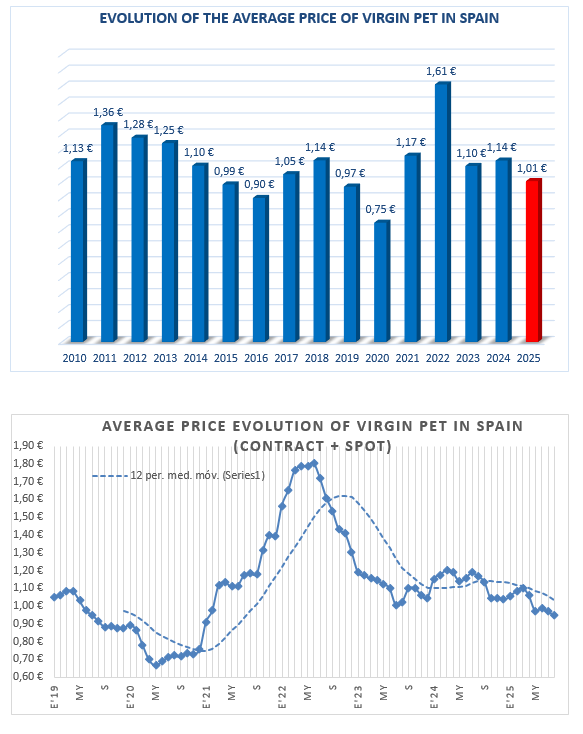
- Strong uptrend (2021 – 2022): The price of PET saw a drastic increase, rising from €0.910 in January 2021 to its peak of €1.803 in July 2022. This period was marked by the energy crisis, supply chain problems and high demand after the pandemic.
- Decline and stabilization (2023 – mid-2024): From the second half of 2022, the price began a sustained decline, reaching its lowest point in 2024 (December) at €1,047. This decline reflects supply chain normalization and weaker demand.
- Moderate recovery (2025): In the first half of 2025, a slight recovery is observed, with prices stabilizing around €1,050 and €1,060, and then falling again.
Paraxylene (PX) and Monoethylene Glycol (MEG):
- There is a strong correlation between commodity prices and PET. PET’s peaks in 2022 coincide with the peak prices of paraxylene (€1,450 in July 2022) and monoethylene glycol (€1,160 in May 2022).
- Similarly, the fall in PET prices at the end of 2022 and 2023 corresponds to the decline in the prices of its components.
Current situation and short-term developments (end of 2025)
Based on the data in the table (August 2025) and market reports such as those from ICIS, the current situation of PET can be described as follows:
- Downward trend: The latest data available in the table, from May to August 2025, show a clear downward trend in the price of PET, which goes from €0.987 to €0.947.
- Falling raw material costs: This decrease in the price of PET is directly related to the fall in the costs of paraxylene and monoethylene glycol, which have also decreased in recent months.
- Influence of demand: This price decline suggests moderate demand and a balance between supply and demand, which prevents significant upward pressures. Market reports agree that the demand for virgin PET remains weak, driving this trend.
Conclusion and short-term forecast:
The situation of the PET market in Spain at the end of 2025 is one of falling prices and relative stability. If the trend of its raw materials continues, it is very likely that the price of PET will remain in this line or even fall slightly in the coming months.
Despite this trend, long-term structural factors such as European regulation (which requires a minimum recycled material content) will continue to drive the rPET market, which could lead to a price fork between virgin and recycled PET in the future. For now, the market is governed by cost dynamics and demand.
BRENT
Current situation (September 2025)
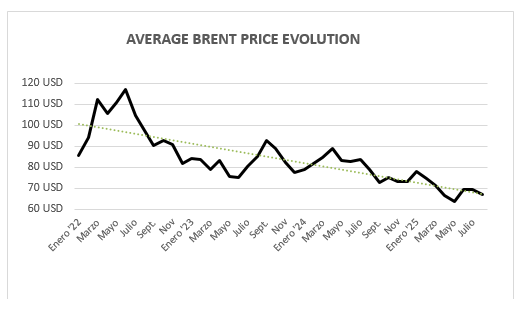
- Price: The price of a barrel of Brent crude oil is in a range of between 65 and 67 dollars per barrel. It has experienced a downward trend in recent weeks and months, with notable falls in August and a slight recovery.
- Context: Current prices reflect a market situation with global supply outpacing demand. Reports from the International Energy Agency (IEA) and OPEC+ indicate that production has increased, led by non-OPEC+ countries (mainly the United States), while demand growth has moderated in key economies such as China.
The evolution of Brent prices is influenced by several interconnected factors:
- Supply and Demand Dynamics: The most determining factor. Currently, rising supply, especially from non-OPEC+ producers, and weaker-than-expected global demand are putting downward pressure on prices.
- OPEC+ decisions: The alliance of producers has been key to managing supply. However, its decision to reverse production cuts has contributed to the current oversupply and falling prices.
- Global Economy: The economic slowdown and central banks’ caution with monetary policies are slowing down the growth of oil demand worldwide.
- Geopolitical tensions: Although oil supply has increased, geopolitical risks, such as tensions in the Middle East, always represent a potential volatility factor that could push prices higher if supply is affected.
Outlook for the end of 2025
Most analysts and agencies such as the EIA and IEA forecast that the market will remain in a relatively stable or downtrend price range for the rest of 2025. The most recent forecasts indicate a wide range, but with an average below the levels of previous years.
- Price forecasts:
- Conservative analysis: Some forecasts put the price of a barrel in a range of between $55 and $65 by the end of the year, arguing that supply will continue to outpace demand, which would keep prices under pressure.
- More optimistic analyses: Other analyses, although minority, do not rule out a slight recovery, especially if demand unexpectedly strengthens in the last months of the year.
- Key factors for the short term:
- OPEC+ production: The main uncertainty is OPEC+’s reaction. If prices continue to fall, the alliance may decide to reimpose production cuts to support prices.
- Demand growth: The performance of emerging economies, especially China and India, will be crucial. If demand in these countries recovers, it could mitigate the downward pressure.
- Inventories: Inventory levels, which have been rising, will continue to be a key indicator of market health.
In short, the Brent market today is characterised by an oversupply and falling prices. The outlook for the end of 2025 points to the continuation of this trend, although the market will remain attentive to OPEC+ decisions and the evolution of global economic growth.
Brent Oil Evolution and Projection for 2025
| MINIMUM PRICE | MAXIMUM PRICE | AVERAGE PRICE | |
| January 2025 | $74.72 | $82.63 | $78.15 |
| February | $72.39 | $77.34 | $74.84 |
| March | $68.33 | $74.81 | $71.32 |
| April | $58.40 | $74.47 | $66.32 |
| May | $58.50 | $66.81 | $63.70 |
| June | $63.00 | $79.40 | $69.39 |
| July | $66.34 | $73.63 | $69.42 |
| August | $64.79 | $72.00 | $67.13 |
GDPR: Data Protection Information of MARSELLÀ GLOBAL S.L. (smarsella@marsellaglobal.com):
PURPOSE: To inform you of our products and services by electronic means. LEGITIMATION: Legitimate interest in keeping you informed in your capacity as a client and/or user. ASSIGNMENTS: Not contemplated. CONSERVATION: During the contractual relationship and/or until you request us to cancel the contract and during the periods required by law to meet any liabilities once the relationship has ended. RIGHTS: You can exercise your right of access, rectification, deletion, portability of your data and limitation or opposition in the email of the responsible party. In the event of disagreements, you can file a complaint with the 72Data Protection Agency (www.aepd.es).
This newsletter is prepared based on the information and experience of our sales team. Marsella Global, SL pays special attention to its preparation, however, we cannot guarantee the accuracy and usefulness of the content published.
The recipient accepts the content of this newsletter on the understanding that Marseille Global, SL is not responsible for any damage caused by the use of the information contained in this document


Comments are closed.